Giving Every Test Run Its Own Fresh Inbox: Why and How
Kieran Goodary
Why give every test run its own fresh inbox?
If you’re running automated tests that involve email-say, verifying signup flows, OTPs, or password resets-sharing a single inbox across test runs is like sharing a toothbrush: it’s messy, unhygienic, and leads to flaky results.
Using a fresh inbox for each test run removes unpredictability. It keeps test data isolated, avoids email collisions, and ensures you know exactly what emails belong to which run. That way, tests aren’t fighting over the same messages or accidentally picking up leftovers from previous runs.
Plus, in CI/CD pipelines, parallel tests are common. Without a unique inbox per test, you get cross-talk, which means your tests might start failing randomly because the inbox got cluttered or emails arrived out of order. Trusting a clean inbox each time means fewer flaky tests.
How does a fresh disposable inbox improve email testing?
disposable inbox is designed to be ephemeral and standalone. When you generate a new inbox for every test run, you gain several advantages:
- Isolation: No risk of old emails confusing current tests.
- Reproducibility: You can trace exactly which emails were sent and received per run.
- Cleanup: No tedious manual inbox cleaning or complex filtering needed.
- Parallelism: Run tests concurrently without email overlap.
It’s the difference between testing email flows in a real, noisy mailbox versus a clean sandbox tailored to every execution.
Why not just share one Gmail or similar email account?
Sure, you could create a dedicated test Gmail account and hard-code it into your tests. But... why would you want to make life harder?
Shared inboxes add complexity:
- Email overload: Over time, test emails build up, making it easy to miss the correct email.
- Brittle logic: You need complicated filters or fragile subject matching to pick the right message.
- Parallel test collisions: Multiple tests send emails simultaneously-how do you know which email matches which test?
- Security risks: Passwords stored in CI environments and shared credentials raise risks.
In short, shared inboxes invite flakiness, brittleness, and unmaintainable test code.
What about using pattern matching instead of unique inboxes?
Developers often try to extract OTPs or verify emails by parsing messages using regexes on a shared inbox. The problem? Regexes are brittle.
Email content format can vary: HTML vs plain text, localizations, template tweaks. Even a minor wording change breaks your regex and brings down your tests.
Using a unique inbox per run means you can rely less on fragile content matching and more on solid identification of the exact message. It also enables webhook-driven workflows where the test is triggered by receipt of the right email.
How can we create and manage fresh inboxes programmatically?
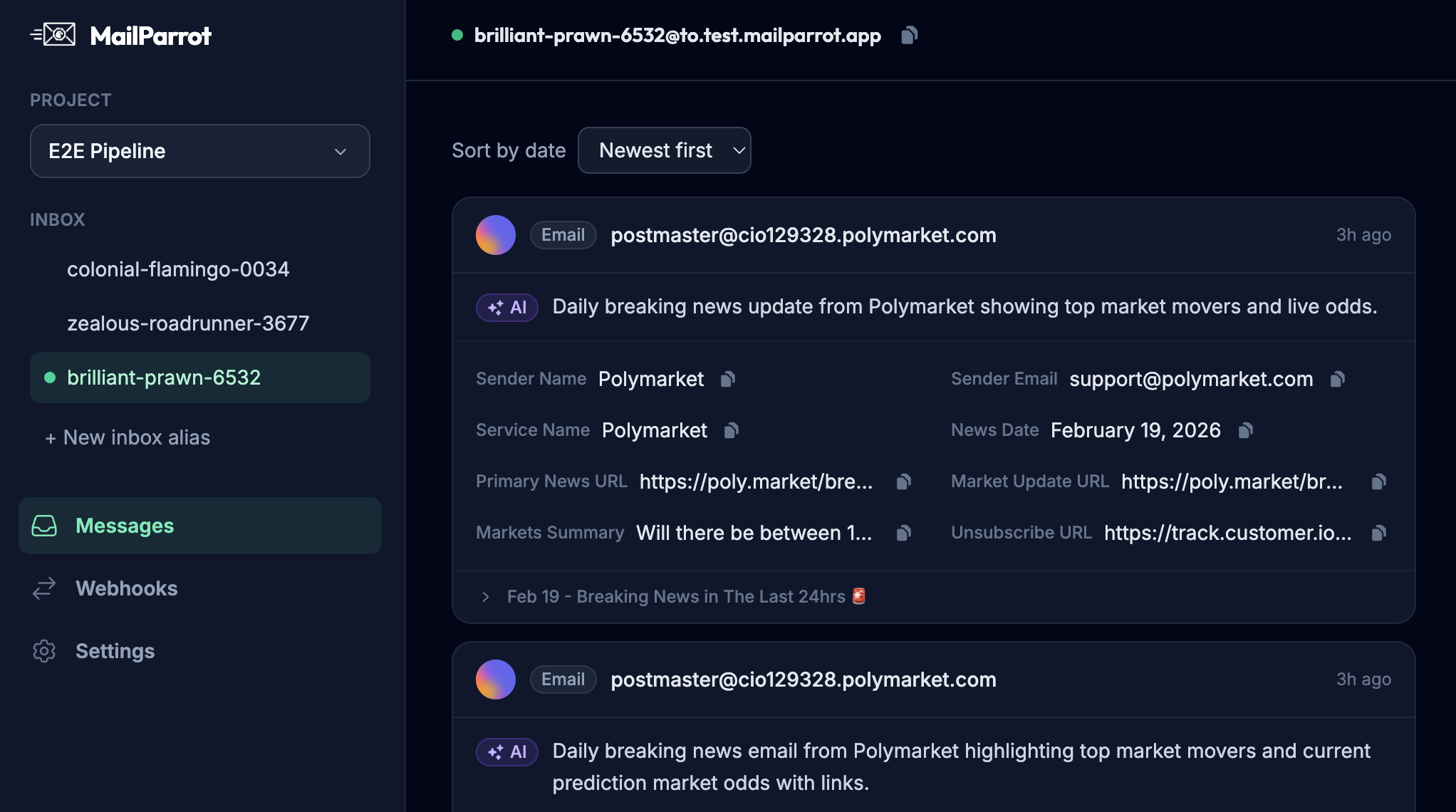
That’s where inbox automation APIs come in. Services like MailParrot let you generate unlimited disposable inboxes on the fly, via API calls. You spin up a fresh email address, send your test emails there, fetch the messages or parse OTPs, then discard the inbox.
You do all this within your test scripts or CI pipeline. This approach fully automates the cycle: no manual setup, no cleanup, no shared state.
Typical flow:
- Request a new disposable inbox address from the API.
- Use this inbox address in your test signup, auth, or email-sending operation.
- Poll or receive webhook notifications when an email arrives.
- Extract the needed data (OTP, verification link) programmatically.
- Let the inbox expire automatically or delete it explicitly.
How does this fit into CI/CD workflows?
Imagine a pull request that triggers a full end-to-end test suite, including user registration flows that require email verification. If each test run uses a fresh inbox, the tests won’t interfere with each other and won’t leave clutter behind.
This approach dovetails nicely with containerized or ephemeral build agents since you don’t need persistent shared services. Your build agents spin up, grab disposable inboxes, run tests, and tear down everything cleanly.
No more test flakes caused by unpredictable email states.
Can fresh disposable inboxes improve privacy and security?
Absolutely:
- No real personal data: Your tests don’t have to use your own email addresses.
- No stored passwords: Disposable inbox APIs don’t require managing mailbox credentials.
- Isolated data: Each inbox is only valid for the test duration, limiting data exposure.
This reduces your risk footprint and keeps sensitive info out of build logs and environments.
What about extracting OTPs or links-how does fresh inbox help?
Unique inboxes make it straightforward to target the exact email you care about, avoiding guesswork.
You can either poll the inbox or use webhooks to capture incoming mail instantly. Then, extract the OTP or verification URL from the email body reliably because you know this email belongs only to your test.
No need to sift through a pile of unrelated emails, and you avoid fiddly regexes that break all the time. You can even assert email content structure because your tests control the entire flow.
How to avoid common pitfalls with disposable email testing?
A few tips to keep your test email setup sane:
- Use reliable disposable inbox services: Avoid questionable or unmaintained free providers.
- Respect rate limits: Test runs can be numerous; make sure your inbox provider handles volume.
- Secure your API keys: While disposable inboxes avoid shared passwords, API keys used to create them must be secured.
- Keep inbox lifetime aligned: Don’t keep inboxes alive forever-clean or expire to reclaim resources.
Summary: Making email verification boring and reliable
Assigning a fresh disposable inbox per test run may sound like extra overhead, but it’s the only way to make email testing repeatable and maintainable.
It saves you from flaky tests, fragile regex hacks, endless email cleanup, and shared inbox chaos.
Automating inbox creation and extraction within your CI/CD pipeline yields reliable, private, and secure email testing.
If you handle even a modest volume of email-driven tests, giving every test run its own fresh inbox is not just a nice-to-have-it’s essential.
--
If you're curious to explore disposable inbox APIs designed for developers with CI/CD in mind, check out MailParrot. We built it to take the headache out of email testing so you can get back to coding.
Ready to unblock your tests and pipelines?
1,000 free credits with every account-no card required. They don’t expire.
Get started for free