Why One-Time Inboxes Are Game-Changers for Sign-Ups and Trials
Kieran Goodary
What exactly is a one-time inbox?
A one-time inbox, also known as a disposable or burnable inbox, is a temporary email address that lives just long enough to receive a few emails and then disappears into the void. Imagine you need to sign up for a service or test an onboarding flow, but you don’t want to use your real email-or you want to automate testing without cluttering your inbox. That’s where one-time inboxes come in.
Instead of juggling shared Gmail accounts or setting up complex email servers, you generate a unique email address programmatically, grab the incoming messages (including verification codes or welcome emails), then toss it when done. No mess, no fuss, no risk of spam escalation.
Why are one-time inboxes useful for users during sign-ups and trials?
People guard their email like a last slice of pizza. In 2024, privacy matters more than ever, and users are tired of emails they never signed up for flooding their inboxes. One-time inboxes provide a neat solution for the common scenario: "I want to try this service, but only for a little while, and I don’t want my email turned into a marketing minefield."
Using a disposable email address gives users control over their digital footprint:
- Avoid spam: If the service turns out to be less than stellar or decides to sell your email, it’s not your real inbox on the line.
- Privacy protection: Protect your main email from data leaks, phishing campaigns, or unwanted tracking.
- Simplified trial sign-ups: No need to create a new email or remember a throwaway login; just generate a quick inbox and go.
This lets users explore services without commitment or digital clutter, lowering the barrier to entry and reducing churn caused by email-related fears.
How do one-time inboxes help developers and product teams?
Behind the scenes, product and engineering teams wrestle with email verification and authentication flows that seem simple but are notoriously flaky to test repeatedly and reliably. One-time inboxes act as a reliable Swiss Army knife for these challenges.
Automated testing made less awful
In continuous integration (CI) and end-to-end (e2e) testing, nothing is more painful than brittle email verification. You want to test things like:
- User sign-up with email confirmation
- Password resets
- One-time passwords (OTPs) sent via mail
But using static emails means cleaning inboxes, manually resetting accounts, avoiding concurrent test collisions, or dealing with rate limits from email providers.
Disposable inboxes let you generate unique emails on-demand, hook into webhooks or APIs to capture incoming messages, and extract tokens or links reliably using structured parsing-not brittle regex that breaks every Monday. This means your automation doesn’t get stuck waiting for an email that never arrives or parsing failures that swamp your logs.
No shared Gmail accounts, no drama
Teams often hack together shared inboxes (like shared Gmail accounts) to catch these confirmation emails. That’s begging for trouble:
- Password sharing nightmares
- Risk of accidentally clicking on real user emails
- Cumbersome manual cleanup
One-time inbox APIs give each test or user its own isolated email endpoint, no guessing which email contains the right OTP.
Improved feature development and debugging
Rather than funneling all email through a single mailbox that turns into an endless stream of unread messages, developers can instantly access fresh inboxes tied to a test cycle or user session. It’s easier to reproduce bugs, verify fixes, or test edge cases like multiple email flows simultaneously.
What about security and reliability?
You might worry disposable inboxes are spam magnets or untrustworthy for serious operations. In reality, they can be designed to be airtight for testing and trials:
- They only live as long as needed.
- Their lifespan is controlled to avoid misuse.
- The API access and logs provide audit trails.
- OTP extraction is precise, with built-in parsers or user-defined rules.
The trick is to avoid using disposable inboxes as a permanent identity solution; treat them as ephemeral, single-use for freeing you from email friction during sign-up and trial phases.
Can you really replace email verification with one-time inboxes?
Yes - if you use them as part of your test harness or trial flow. For permanent user accounts, real inboxes remain king; users need real access to password resets, notifications, and legal communications. But for that crucial first step of onboarding - verifying a user is a real person and checking your auth systems work - disposable inboxes shine.
They help simulate the end-user experience without adding manual steps or leaving open accounts with test data dangling around.
How do OTP extraction and webhooks fit into the picture?
A neat feature of good one-time inbox solutions is OTP extraction. This means the API doesn’t just dump raw email content; it actually pulls out the verification code or magic link you need to proceed.
Combine that with webhooks and you get near real-time event-driven workflows:
- Email arrives
- OTP or link is parsed
- Your test clicks the link or inputs the code programmatically
This hands-off automation tames the beast of async email flows in testing and trials, making them less flaky and more predictable.
Why not just write regex against a shared Gmail inbox?
Regex against human-written emails is a tragicomedy. It's prone to breaking with the slightest template change, word wrapping, or encoding quirks.
Shared Gmail inboxes introduce synchronization headaches, race conditions, and manual maintenance hell.
One-time inboxes paired with dedicated parsing and structured access make this a non-issue. You get deterministic behavior, less flapping tests, and happier developers.
How do you get started with one-time inboxes for your sign-ups and trials?
First, pick a solution that offers:
- Simple API for creating temporary email addresses
- Programmatic access to incoming messages
- OTP and link extraction support
- Webhooks for event notifications
- Short lifetimes and data purging
Then plug it into your existing sign-up or test flows. Start by automating your OTP flows or confirmation email parsing, then expand to handling password resets and other multi-step email flows.
Keep your real users’ inboxes clean; use disposable inboxes for those "what if" moments and automation shenanigans.
Closing thoughts
One-time inboxes are a developer’s best friend for making email verification and trial sign-ups less annoying, more private, and much easier to test reliably. They give users the freedom to try services without commitment or spam risk, and give engineering teams tools to automate and troubleshoot email flows without flailing over shared inbox chaos.
They’re not a replacement for permanent email accounts but a tactical tool to smooth the messy edges of sign-ups, trials, and authentication in a way that’s, dare I say it, downright boring - and that’s exactly what you want.
If you’re struggling with flaky email tests or want to offer frictionless trials, it’s time to get acquainted with disposable inboxes. Your inbox-and your sanity-will thank you.
Ready to unblock your tests and pipelines?
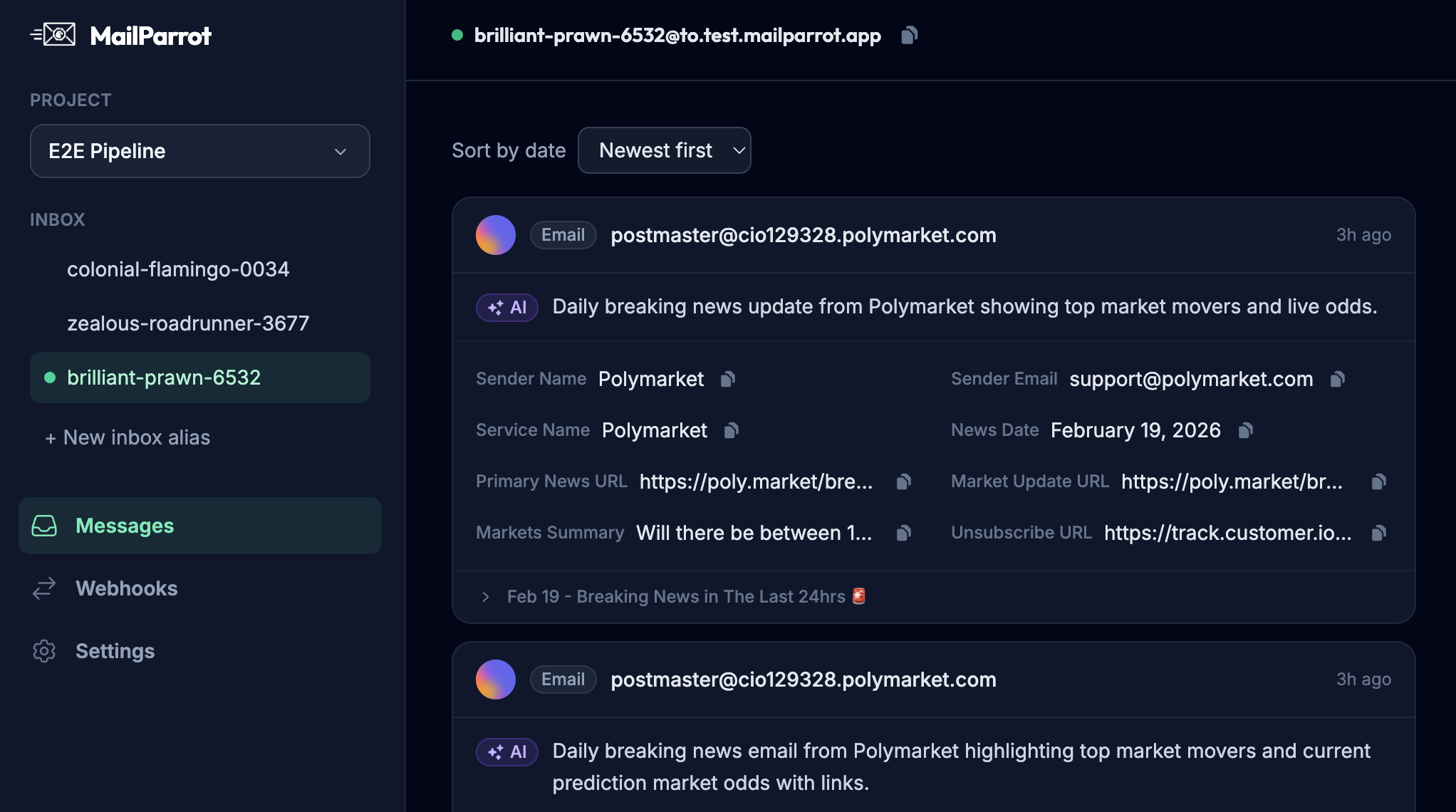
1,000 free credits with every account-no card required. They don’t expire.
Get started for free