Giving Every Test Run Its Own Fresh Inbox: Reliable Email Testing for Devs
Kieran Goodary
Why should you assign a fresh inbox to every test run?
Imagine this: your tests send emails-verification codes, welcome messages, password resets-and you’re scraping a single shared inbox to confirm everything arrived. Sounds straightforward, right? But then test runs collide, emails pile up, and your regex starts failing because emails from previous runs muddy the waters. Suddenly, your precious CI pipeline is flaky, sometimes succeeding, sometimes not, with no clear reason.
Assigning each test run its own fresh, disposable inbox eliminates this mess. You get complete isolation between test runs, so no leftover emails interfere with your assertions. There’s no need to sort through a haystack of messages or worry about race conditions caused by parallel tests polluting a shared inbox.
This separation makes your tests deterministic and reliable. If the right email is sent, your test can immediately grab it and proceed, confident it’s the correct message.
How do fresh disposable inboxes improve privacy and development speed?
Aside from benefiting your test pipeline, disposable inboxes enhance privacy during development and manual testing. Ever sign up for a new service repeatedly, just to test a flow? Using your personal or work email clutters your inbox, invites spam, and risks accidentally leaking test data.
A fresh disposable inbox keeps your real mailbox clean and private. You get to test sign-up flows, trial user experiences, or invite emails without worrying about contamination. Plus, since these inboxes are short-lived, no one’s scrolling back through weeks of unwanted email history.
For teams, this means quicker iteration. If you’re manually testing features like OTP login or email confirmation steps, you can spin up inboxes on-demand without setup headaches or cleanup.
What problems arise when developers use a shared Gmail or similar mailbox?
Many teams default to sending test emails to a shared Gmail address or something equivalent. It works-to an extent. But the problems creep up quickly:
- Email pile-up: Old emails clog the inbox, making it tricky to identify or extract the right message without brittle filters.
- Race conditions: Parallel test runs can see emails from each other, causing false positives or negatives.
- Rate limiting and spam flags: Shared inboxes frequently get flagged or rate-limited by email providers, especially if many tests generate traffic.
- Regex headaches: Parsing Gmail content requires complex patterns that are fragile and break with minor email template changes.
Using a shared mailbox turns email verification from a boring, dependable step into a frustrating puzzle requiring fragile hacks.
How does programmatic inbox generation fit in CI/CD pipelines?
Modern software projects leverage continuous integration and continuous delivery for fast feedback and rapid releases. Your test suite-especially end-to-end (e2e) tests-should be part of that.
But email flows complicate this picture. How do you verify that emails get sent correctly and that content (like OTP codes or magic links) is accurate and fresh? Hardcoding email addresses or relying on a shared inbox is a recipe for flaky tests.
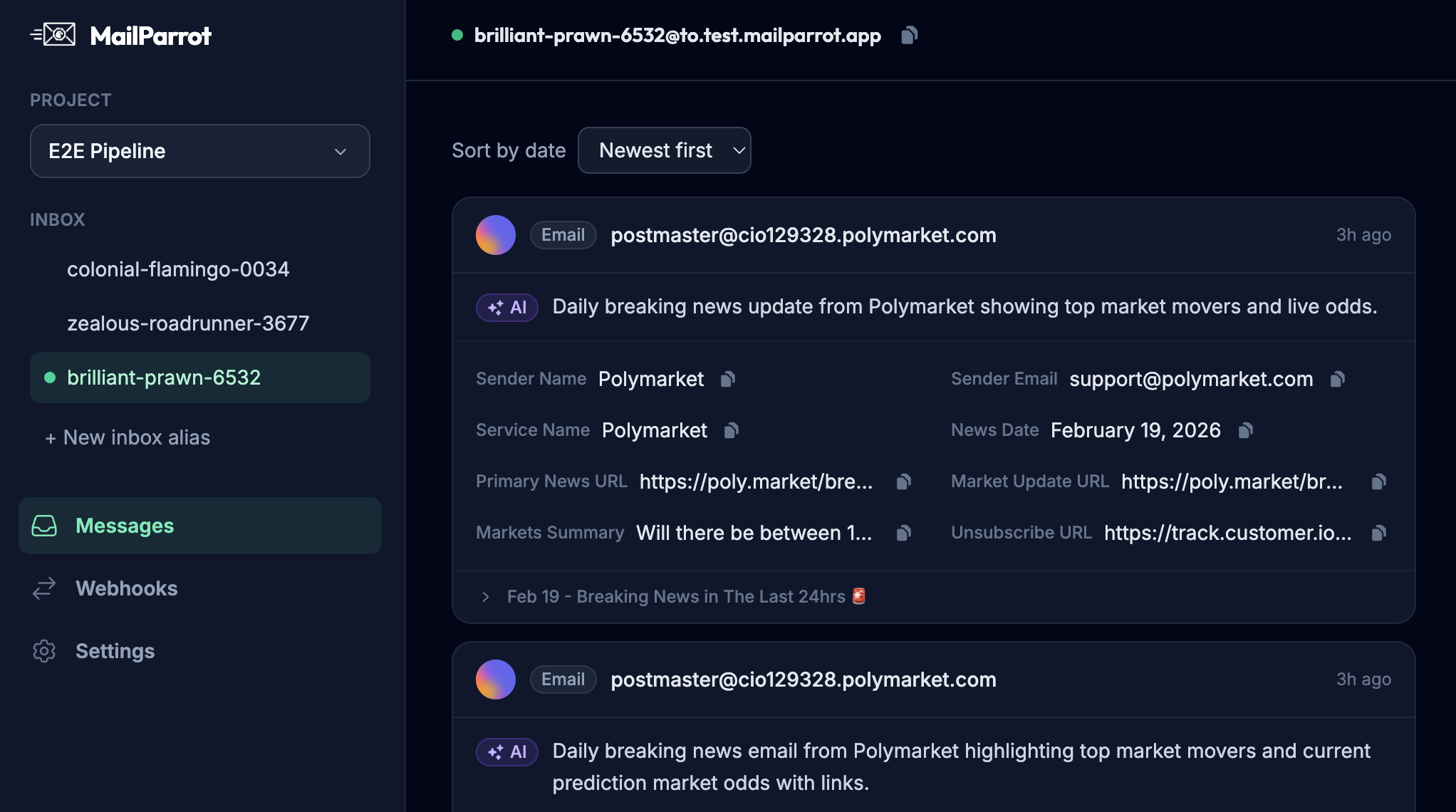
Programmatically generated disposable inboxes fit perfectly here. Each CI job or test run requests a unique, API-generated inbox, waits for incoming messages, extracts needed content, and performs assertions-all automatically and reliably.
This integration reduces human intervention, speeds up testing cycles, and ensures tests remain stable and reproducible regardless of how often or massively you run them.
What is OTP extraction, and why is it tricky without fresh inboxes?
One of the most common email verification scenarios is dealing with one-time passwords (OTPs) or magic login links. Your tests need to extract these codes from incoming emails reliably and fast.
Without fresh inboxes, OTP extraction involves:
- Sorting through potentially hundreds of old emails to find the right one.
- Handling delays or duplicates caused by previous test runs.
- Writing complex and brittle regex or parsers for the email body, which may change frequently.
With a fresh disposable inbox created just for the test run, only the current OTP email lands there. This means your extraction logic is simple: wait for the first (or nth) email, parse its body, grab the code, and move on.
The simplicity drastically reduces the chance of false negatives and flaky failures caused by timing or messiness.
How can you make email verification boring but reliable? Isn’t that an oxymoron?
Yes, email verification usually sounds like a chore, but in testing it should be boring and reliable-because that means you’ve nailed it.
The key to boredom is automation with minimal surprise. When your test automatically:
- Spins up a fresh inbox via API
- Waits for the expected email without timeout surprises
- Extracts the needed content with simple, robust parsing
- Cleans up gracefully after the run
You remove the emotional rollercoaster of chasing flaky tests or triaging email issues.
The net result is confidence. You know your email flows work as expected, and your CI system doesn’t choke on messy inboxes or fragile regex. Your dev team wastes less time
Ready to unblock your tests and pipelines?
1,000 free credits with every account-no card required. They don’t expire.
Get started for free