Giving Every Test Run Its Own Fresh Inbox: Why and How
Kieran Goodary
Why do you even need a fresh inbox for every test run?
At first glance, you might think: “Can’t I just reuse the same email inbox for all my tests? How messy can it get?” Well, quite messy actually. Reusing a single inbox in Continuous Integration (CI) or end-to-end (E2E) tests that involve email verification often leads to flaky, unreliable test runs. Emails pile up, race conditions crop up, and your parsing logic becomes brittle because you have to sift through old, irrelevant messages.
Tests should be predictable and isolated. Giving each test run its own fresh, disposable inbox guarantees zero interference from past runs. This isolation is what makes email-based sign-ups, password resets, and OTP validations consistently testable. You get reliable results without rummaging through the clutter.
How do disposable inboxes help normal users and testers alike?
For normal people-not just engineers-using disposable inboxes can protect privacy when signing up for trials, newsletters, or services you want to try without permanent commitments. It's a simple privacy shield: a burner email that collects messages for a short time before self-destructing.
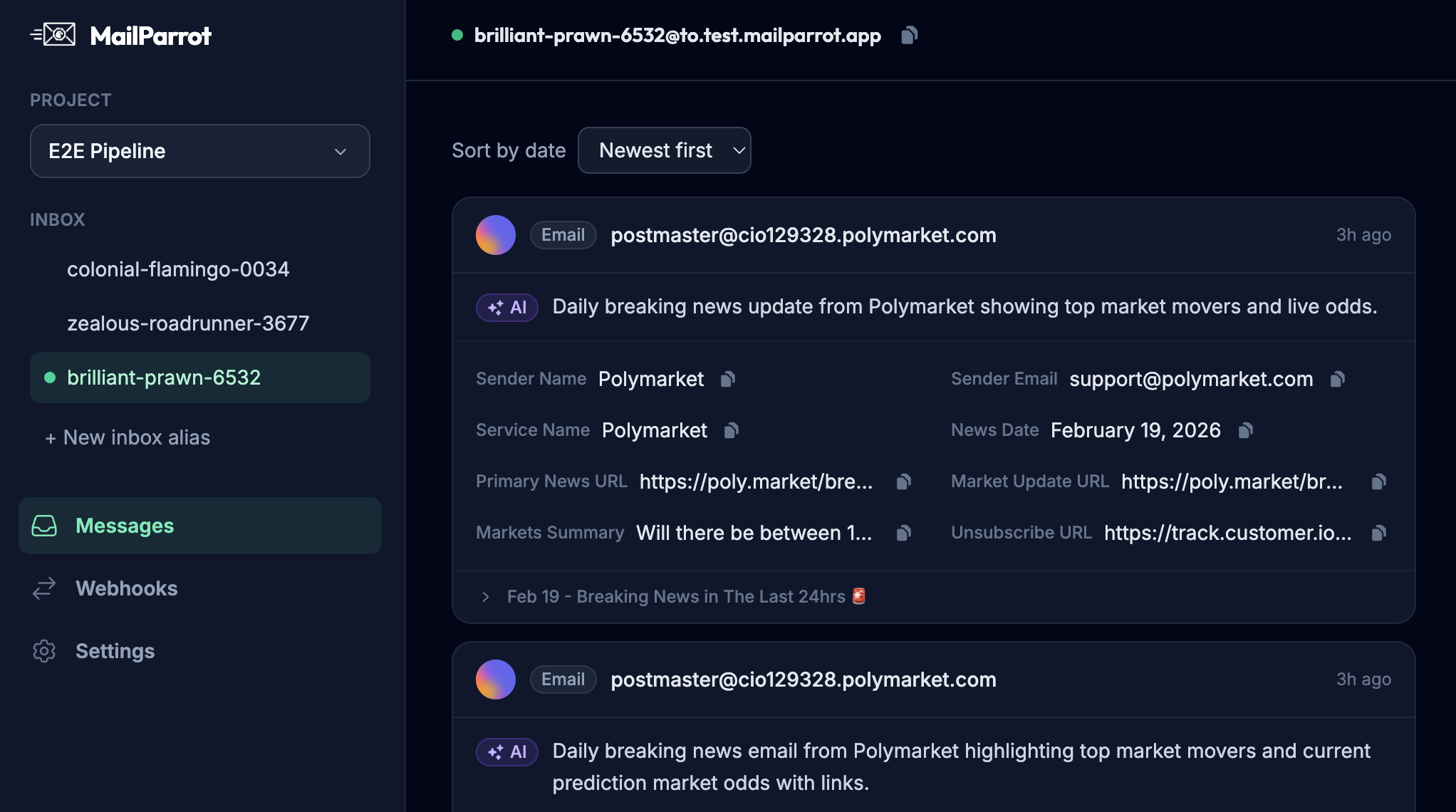
For testers and developers, these inboxes are a goldmine. Instead of sharing a corporate Gmail account or generic inbox, you spin up fresh inboxes on demand, programmatically accessed via APIs. Each email address is a sandbox, giving complete control over which messages arrive, when, and what to do with them-perfect for automating email verification flows.
Why not just use a shared Gmail account or a catch-all email?
Shared Gmail inboxes are a headache in automated testing. Several issues crop up:
-
Race conditions: Multiple tests racing to read or delete emails.
-
State leakage: Leftover emails from previous runs causing false positives or weird failures.
-
Brittle parsing: Needing complex regex or fragile rules to pick the right email from dozens.
-
Access problems: OAuth tokens expire or 2FA triggers, breaking automation.
A catch-all inbox is slightly better but still shared state. If five tests simultaneously sign up users, how do you know which email belongs to which test? You don't-unless you built careful tagging or filtering logic, which is extra work and fragile.
Disposable inboxes solve these by providing guaranteed fresh state, no confusing old emails, and direct API access with no UI or OAuth hassles.
How does giving every test run a fresh inbox make CI/CD more reliable?
CI/CD pipelines depend on repeatable, deterministic tests. If your E2E flows involve clicking a verification link or extracting a one-time password (OTP) from an email, the last thing you want is to fail sporadically because the inbox is cluttered or stale.
By starting each test run with a freshly minted email inbox:
-
You eliminate pollution from previous runs.
-
Your parsing logic works on exactly one email for that run, simplifying OTP extraction.
-
You can parallelize tests infinitely, each with its own inbox.
-
You remove the dependency on UI-based email clients that might change or break.
-
Your test runs become faster and less flaky, which your team will thank you for.
In short, fresh inboxes tame the notorious email step in your E2E tests.
What about OTP and magic link extraction? Why is a disposable inbox better?
Parsing OTPs (six-digit codes, magic links, reset tokens) from emails is an age-old pain point. Usually, teams hack together fragile regexes that break when the email format slightly changes.
Disposable inboxes accessed via API allow you to:
-
Programmatically wait for the exact email tied to your test.
-
Extract tokens with simple, deterministic parsing on a message guaranteed to be the right one.
-
Automate retries and timeouts, knowing the inbox is fresh and the expected email will arrive.
-
Hook webhooks on incoming emails to trigger downstream steps instantly.
Compare this to dealing with shared inboxes where you must filter dozens of emails, with inconsistent timing and content.
With fresh inboxes, token extraction becomes boring-which, for testers and engineers, is exactly what you want.
How do you integrate disposable inboxes into your test automation?
Here’s the high-level approach you can adopt:
-
Create a new disposable inbox at the start of your test run or test suite. Use an API that returns a fresh, unique email address.
-
Inject this email address into the system under test. For example, use it when signing up users or requesting password resets.
-
Poll or receive webhook notifications for new emails sent to this inbox.
-
Parse the incoming message(s) for verification links or OTPs.
-
Complete your test flow by feeding the extracted token/message back into the system under test.
-
At test completion, clean up or allow the disposable inbox to expire.
This flow is entirely automatable and fully supports parallelism and flaky test reduction.
What should you look for in an email testing inbox API?
Not all disposable inbox APIs are created equal. When picking one, keep these in mind:
-
Real inboxes, not just email simulators: You want messages to actually arrive reliably, from any sender.
-
API-first design: Easy to create inboxes, retrieve emails, parse contents, and delete messages.
-
Webhook support: Get notified when new emails arrive instead of polling.
-
Data privacy: Don’t entrust your test data to a provider with lax policies.
-
Built for developers: Simple, language-agnostic SDKs or REST APIs.
-
Scalability: Can handle hundreds or thousands of inboxes simultaneously in CI environments.
-
Custom domains or prefixes: To ensure emails come from expected senders and pass SPF/DKIM checks if needed.
Can disposable inboxes replace real email in testing completely?
Nope. They’re a vital tool but not a complete replacement for real user testing or manual QA.
You still want to validate that your emails render correctly in actual inboxes (Gmail, Outlook, mobile clients) before shipping. Disposable inboxes handle the verification and token extraction part spectacularly, but they don’t cover UX and client-specific quirks.
However, for automation, CI stability, and frequent regression testing, fresh disposable inboxes are the way to go-they make the email step boring, reliable, and programmatic.
Summing up: Why does your test run deserve a fresh inbox?
Because email verification flows are often the most fragile part of E2E testing, and flaky email steps undermine your entire pipeline reliability. By assigning each test run its own disposable, programmatically accessible inbox, you create a controlled, isolated environment where OTPs and verification emails arrive predictably and parsing works without hacks.
This simple step:
- Improves test reliability
- Accelerates CI/CD
- Removes manual or brittle regex extraction
- Supports parallel and scalable test suites
It might seem like an extra implementation detail but it pays for itself many times over by turning dreaded email testing into a mundane, boring step-exactly what you want.
So grab that disposable inbox API, automate inbox creation and token extraction, and give every test run its own fresh inbox. Your future self (and your team) will thank you.
Ready to unblock your tests and pipelines?
1,000 free credits with every account-no card required. They don’t expire.
Get started for free